Appendix A - BS 8243
BS8243:2010 Methods of Completion of Setting
The completion of the full setting procedure should be achieved by one of the following methods:
a) Shunt lock fitted to the final exit door
To achieve setting with this method use a ShuntLck Zone type on the main exit door. Closing the Shunt lock zone will complete setting of the system when all entry and access route zones have closed.
b) Push button switch mounted outside the supervised premises
To achieve setting with this method use an ExitTerm Zone type outside the protected premises. Opening or closing an Exit Term Zone type will complete setting of the system when all entry and access route zones have closed.
c) Protective switch (i.e. door contact) fitted to the final exit door of the alarmed premises or area
To achieve setting with this method use an Entry/Exit Zone type contact on the main exit door and enable the Final Door Option in System Options - Arming Options Menu.
d) Digital key
To achieve setting with this method present a HKC proximity tag to the tag reader on the keypad then complete the arming process using one of the above methods.
The setting procedure should always be a two-stage process of initiating the setting procedure within the supervised premises (e.g. using digital key or other secure means such as a code number) followed by completion of setting by the relevant method.
All of the above options prohibit the use of a timed exit procedure whereby, following initiation of the setting procedure, the IAS (Intruder Alarm System) sets after a given time has elapsed. To achieve this, the Infinite Exit option in System Options Menu - Arming Options Menu must be enabled.
BS8243:2010 Supported Unsetting Methods
Clause 6.4.2: Prevention of Entry to the supervised premises before the Intruder Alarm system (IAS) is unset
Users should be prevented from gaining entry to the supervised premises before the IAS (Intruder Alarm System) has been unset through the use of a lock with an electrical connection to the IAS.
Method a) has been chosen for this purpose i.e. Unlocking the initial entry exit door causes the IAS to be unset.
To achieve this method of unsetting, a ShuntLck Zone type should be used with the Unset option on this zone set to YES. When the System is Armed, Opening a Shunt lock zone Unsets the system. An Entry/Exit Zone should also be used on the entry door in this case. If any Entry/Exit zone is forced open When System is armed, this will generate an instant unconfirmed Alarm activation, with no entry timer. If another Alarm zone is activated, a confirmed alarm is generated. Please refer to table on page 116 for all recommended programming settings.
Closing the ShuntLck zone type will complete setting of the system when arming the panel.
Clause 6.4.3: Prevention of Entry to the supervised premises before all means of intruder alarm confirmation have been disabled
Users should be prevented from gaining entry to the supervised premises before all means of intruder alarm confirmation have been disabled by use of a lock with an electrical connection to the IAS.
Method a) has been chosen for this purpose i.e. Unlocking the initial entry exit door causes all means of confirmation to be disabled.
To achieve this method of unsetting a ShuntLck Zone type should be used with the Unset option on this zone set to NO. When the System is Armed, opening a Shunt Lock zone starts the Entry timer. After the initial entry door has been unlocked, all means of confirmation are disabled.
An Entry/Exit Zone should also be used on the entry door in this case. If any Entry/Exit zone is forced open when System is armed, this will generate an instant unconfirmed Alarm activation, with no entry timer. If another Alarm zone is activated, a confirmed alarm is generated. Please refer to table on page 116 for all recommended programming settings.
Closing the ShuntLck zone type will complete setting of the system when arming the panel.
Clause 6.4.4: Opening the initial entry door disables all means of intruder alarm confirmation
Opening the initial entry door disables all means of intruder alarm confirmation throughout the supervised premises so that there is no possibility of a sequentially confirmed alarm at any time after the initial entry door has been opened.
To achieve this method of unsetting an Entry/Exit Zone type should be used with the DisableBV option on this zone set to YES. When the System is Armed, opening an Entry/Exit zone starts the Entry timer. If an alarm activation occurs during entry, and/or as a result of the expiry of the overall entry time an unconfirmed alarm signal is generated. Further alarm zone activations do not generate confirmed alarm events. Please refer to table on page 116 for all recommended programming settings.
Ensure that there are no ShuntLck Zone types configured on the system in this case.
Clause 6.4.5: Completion of unsetting using a digital key
Unsetting can be achieved by means of a single manual action using a digital key and a digital key reader located within the supervised premises, using one of the following options:
a) Operation of an RF Keyfob before entering the supervised premises. b) Operation of a HKC Proximity Tag on the keypad after entering the supervised premises.
In both cases, a timed entry procedure will start if the initial entry door is opened before the IAS has been unset. During the entry time it should only be possible to unset the IAS using a digital key. When the entry time expires, the IAS can be unset with a User code, but this should only be used in exceptional circumstances for example if the proximity tag fails to operate.
If no alarm condition exists, but the entry timer expires before the IAS is unset, an unconfirmed intruder alarm will occur. A sequentially confirmed alarm may occur in accordance with this British Standard if one (or more) independent detectors located off the entry route are activated during or after expiry of the entry time. The Access/BV option should be set to No for this case. Please refer to table on page 116 for all recommended programming settings to comply with BS8243:2010 unsetting methods.
BS8243 Settings Comparison Table
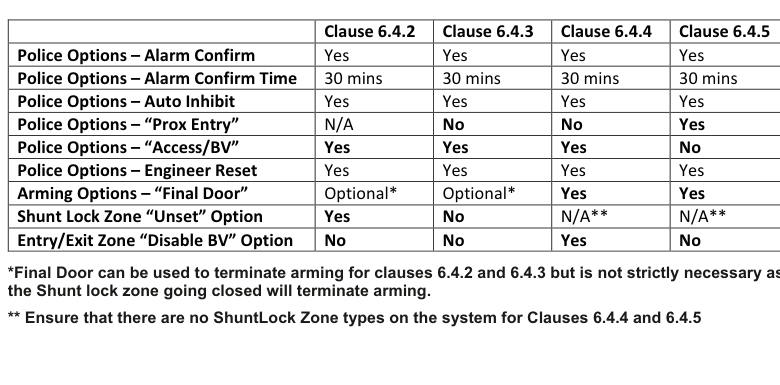
The table below shows the recommended programming settings for each BS8243 unsetting method (Clauses 6.4.2 through 6.4.5), including Police Options, Arming Options, Shunt Lock Zone, and Entry/Exit Zone settings.
| Clause 6.4.2 | Clause 6.4.3 | Clause 6.4.4 | Clause 6.4.5 | |
|---|---|---|---|---|
| Police Options - Alarm Confirm | Yes | Yes | Yes | Yes |
| Police Options - Alarm Confirm Time | 30 mins | 30 mins | 30 mins | 30 mins |
| Police Options - Auto Inhibit | Yes | Yes | Yes | Yes |
| Police Options - "Prox Entry" | N/A | No | No | Yes |
| Police Options - "Access/BV" | Yes | Yes | Yes | No |
| Police Options - Engineer Reset | Yes | Yes | Yes | Yes |
| Arming Options - "Final Door" | Optional* | Optional* | Yes | Yes |
| Shunt Lock Zone "Unset" Option | Yes | No | N/A** | N/A** |
| Entry/Exit Zone "Disable BV" Option | No | No | Yes | No |
*Final Door can be used to terminate arming for clauses 6.4.2 and 6.4.3 but is not strictly necessary as the Shunt lock zone going closed will terminate arming.
**Ensure that there are no ShuntLock Zone types on the system for Clauses 6.4.4 and 6.4.5